
Custom Software vs Off-the-Shelf SaaS: How Enterprises Should Decide
Every software initiative eventually hits the same question: buy a ready-made SaaS product or invest in custom development. Neither choice is automatically smarter. The right answer depends on how unique your workflows are, how tightly software must connect to devices and data you already own, and how much change your teams can absorb after go-live.

What off-the-shelf SaaS does well
Packaged SaaS products ship with predefined modules, roles, hosting and update cadence. That structure reduces time to first login and spreads development cost across many customers. SaaS fits well when the problem is common—school administration, digital signage publishing, device management dashboards—and when your processes can adapt to the product’s model instead of the other way around.
Maram’s own platforms for digital signage, DCM and school management follow this pattern: proven operational workflows, cloud delivery and consoles teams can evaluate before scaling. For many buyers, starting with SaaS is the fastest path to measurable value.
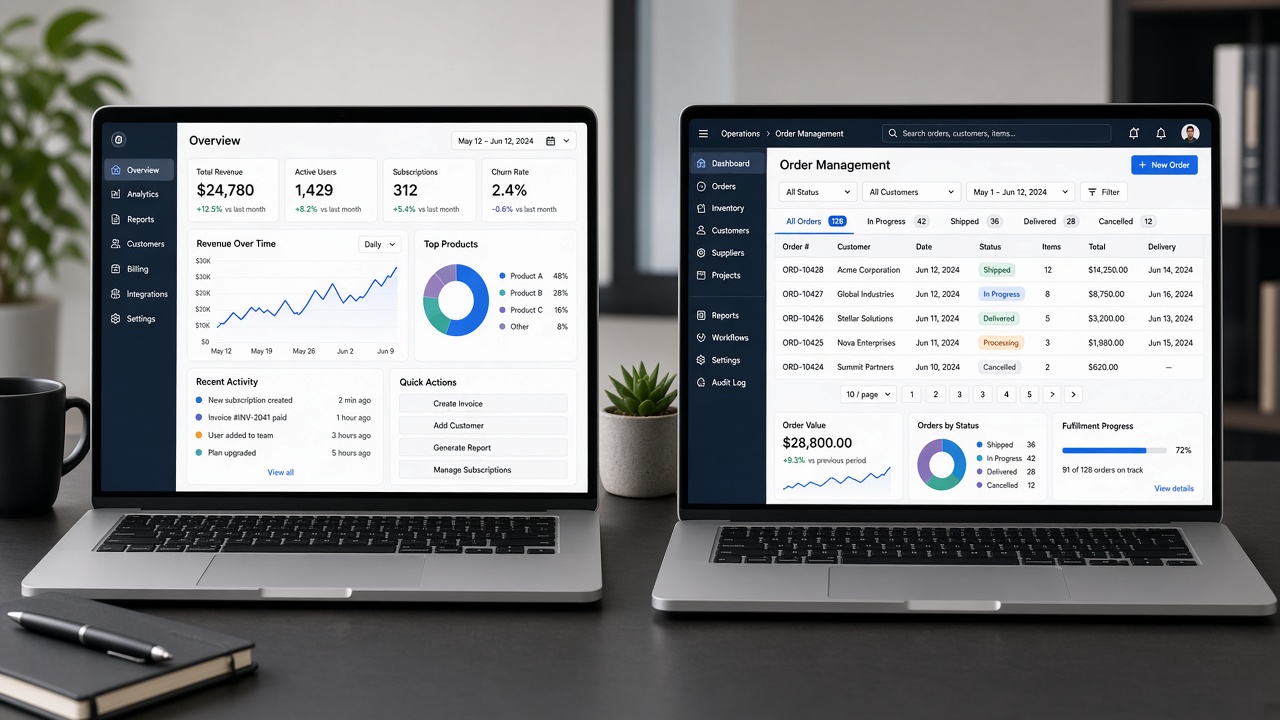
When custom development becomes the better fit
Custom software makes sense when packaged products force awkward workarounds across departments, when integrations are business-critical rather than nice-to-have, or when hardware and firmware are part of the same delivery. Examples include proprietary device enrollment flows, industry-specific compliance steps, multi-tenant partner portals or AI features tied to private data estates.
Custom work also fits when you need long-term ownership of the roadmap—adding modules on your schedule, hosting choices you control, or UX aligned to field teams who cannot retrain every quarter. The trade-off is upfront discovery, build discipline and ongoing support ownership.
Questions that clarify build vs buy
- Process fit: Can 80% of daily work run inside a standard product with configuration, not code?
- Integrations: Do you need deep links to ERP, billing, identity, devices or legacy systems on day one?
- Data ownership: Where must data live, who exports it, and what audit trail is required?
- Change capacity: Can operations adopt the vendor’s workflow, or must software mirror existing habits?
- Hardware coupling: Are Android players, tablets, sensors or touch surfaces part of the same program?
- Timeline: Do you need production value in weeks (SaaS) or can you fund a phased build?
Our SaaS product selection guide walks through operational fit for signage, DCM and school platforms. Use it when the buy path is still open.
The hybrid path many enterprises actually take
Pure build or pure buy is less common than a staged blend: start with SaaS for the core job, extend through APIs and custom modules where differentiation matters, and keep device or edge behavior in firmware or dedicated apps when needed. A retailer might run Maram signage SaaS for content while custom middleware connects pricing feeds. A school might adopt school management SaaS while custom parent portals or local-language reports are added later.
Maram’s development services and AI solutions pages describe how extension work is scoped when a base platform already exists. The goal is to avoid rebuilding commodity features while still owning what makes the program unique.

Cost, risk and support—beyond license vs project quotes
SaaS spreads infrastructure and feature maintenance to the vendor, but subscription totals grow with users, sites and modules. Custom projects concentrate cost early and shift maintenance to your team or a partner unless a support retainer is planned. Compare five-year ownership, not just year-one price: training, integrations, device fleets, security reviews and the staff time to handle exceptions.
Also weigh failure modes. SaaS risk often shows up as process mismatch or integration gaps. Custom risk shows up as scope creep, weak documentation or teams that cannot support releases. Either path needs a named owner after launch.
A practical decision framework
- Choose SaaS when the workflow is standard, speed matters and configuration covers most roles.
- Choose custom when integrations, compliance or device behavior are the product differentiator.
- Choose hybrid when SaaS can run operations while custom layers handle data, AI or partner experiences.
Document the decision in writing: assumptions, integrations, success metrics and what triggers a move from configure to code. That clarity keeps leadership aligned when requests for “just one more custom screen” accumulate mid-project.
Related reading and solutions
Deciding between SaaS, custom build or a hybrid roadmap?
Maram Technologies can help you map workflows, integrations and device dependencies before you commit to a platform strategy.
Talk to Maram